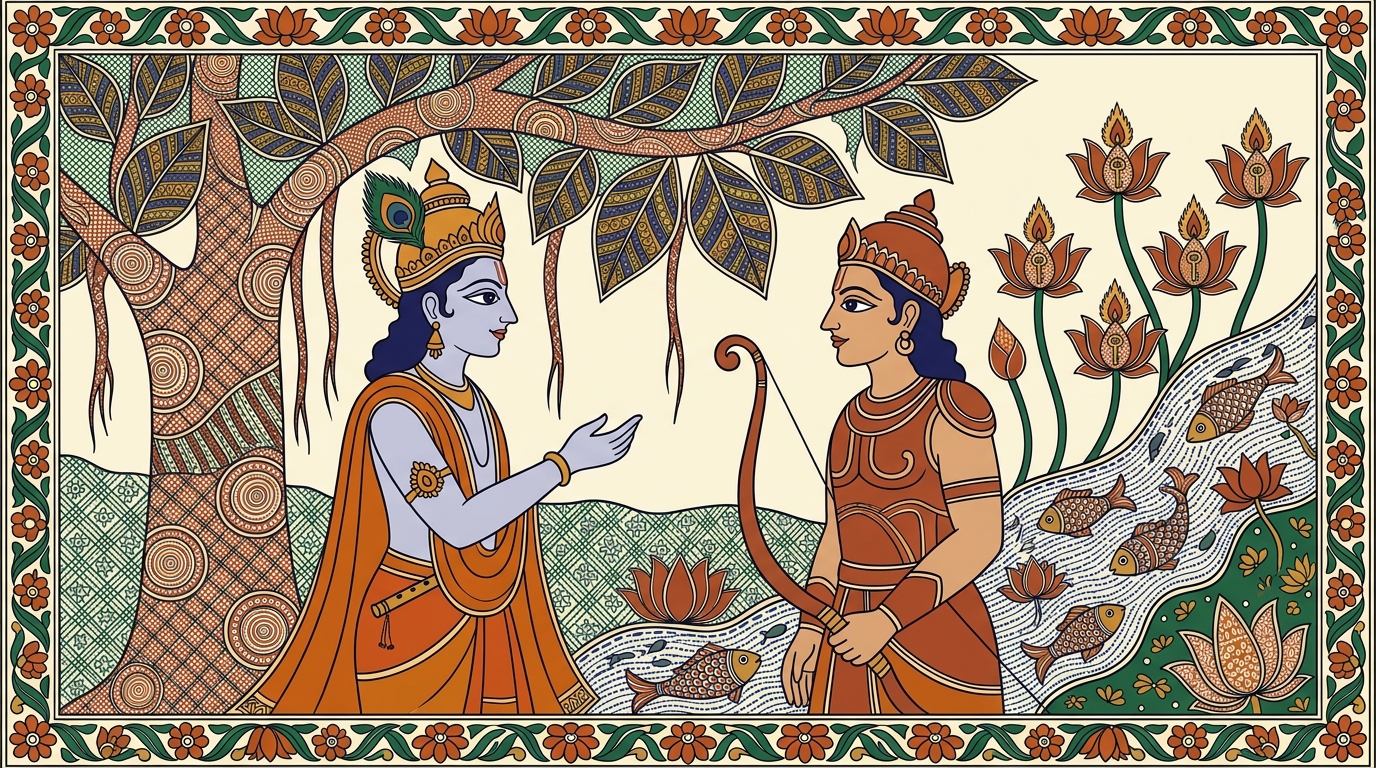
Nani had given Ravi a fishing line for the first time, down at the slow
bend of the Kosi where the village children learned. She expected to spend
the whole afternoon teaching him — how to hold it, how to feel the tug, how
to flick the wrist just so.
But almost at once, something odd happened.
Ravi looped the line around his fingers without being shown. He settled it
against the river's pull as though he had done it a thousand times. When the
first fish nibbled, he did not yank. He waited, then lifted with a smooth,
knowing turn of the hand, and a silver fish came arcing up into the morning
light, flashing.
"Nani!" he cried, half-laughing, half-amazed. "I caught it! But — I didn't
know how. My hands just knew."
Nani sat back on the warm sand and watched him, her eyes soft.
"Your hands," she said slowly, "sometimes remember things your head has
forgotten."
Ravi frowned, the fish dangling and wriggling. "What do you mean?"
She thought about how to say it to a nine-year-old. "You know how, when you
learn something hard, really learn it, deep down, it stops living in your
head and goes into your hands, your bones? You don't think about it anymore.
You just do it."
Ravi nodded, freeing the fish carefully and slipping it back.
"Well," Nani said, "some old teachers believed that the deepest things we
learn don't even leave us when our life ends. They wait, quiet, and come
back to us later — and then we learn the next part faster, because part of
us already remembers. Perhaps your hands learned the river a long time
before this morning."
Ravi looked at his own fingers, turning them over as if they belonged to a
stranger who knew secrets.
"So I don't always start from the beginning," he said.
"No, beta. Nobody truly does. Every good thing you ever learn waits for you,
patient as this river. And the next time you reach for it, you reach a
little further than before."