Before there were forests, before there were rivers, before there was even
a sky to hold the sun — there was a great stillness, and out of that
stillness came a thought.
The Creator, Brahma, sat upon a lotus in the vast quiet, and he wished for
the worlds to be filled with life. He did not build the first beings with
his hands. He did not shape them from clay. He simply thought them — and
they appeared, glowing softly, as real as if they had always been.
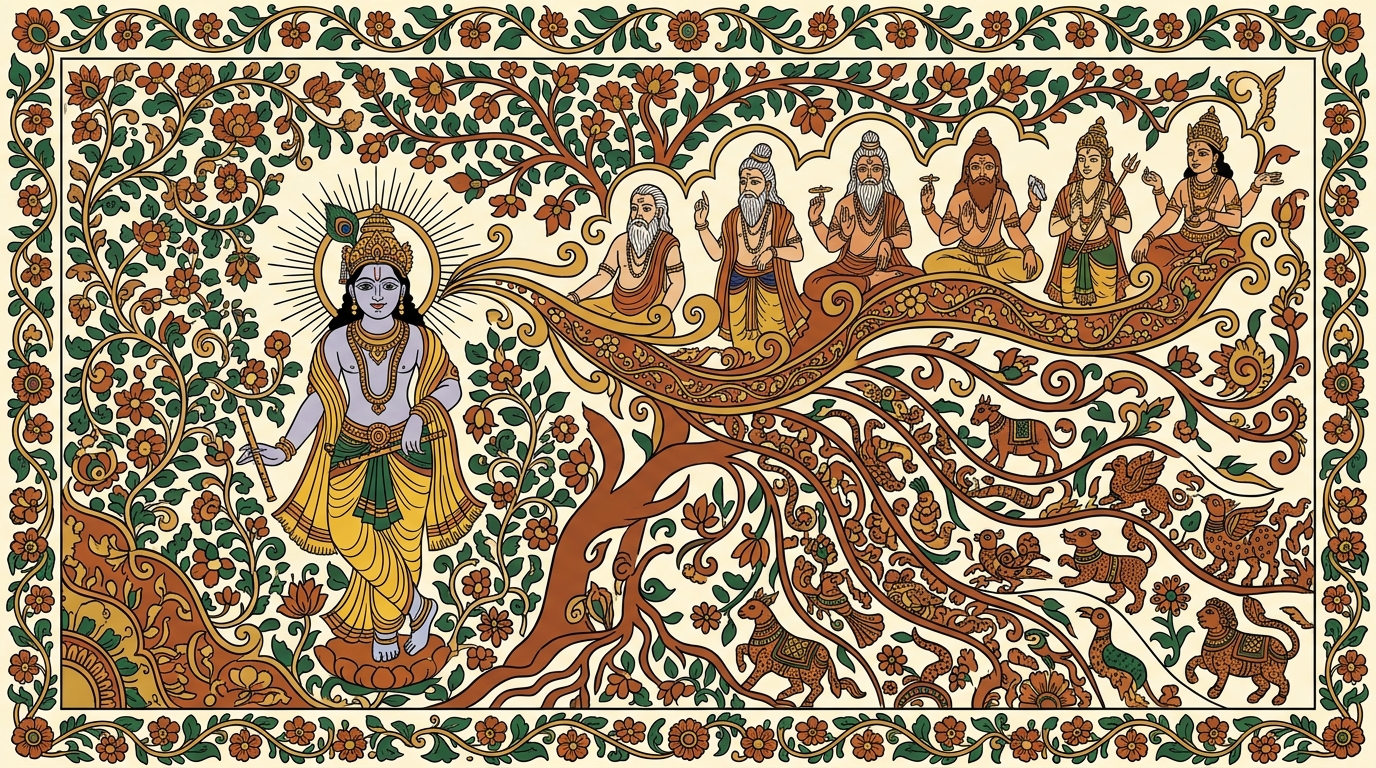
First came four shining children, the most ancient of all — Sanaka, Sanandana,
Sanatana, and Sanatkumara. They came into being already wise, already calm,
their eyes full of a peace older than time. They had no wish for kingdoms or
power. They wandered off at once to wonder at the mystery of things, forever
young, forever seeking the truth.
Then Brahma thought again, and seven great sages rose up — the Saptarishis.
Marichi, Atri, Angiras, Pulastya, Pulaha, Kratu, and Vasishtha. They were
born for a different task: to carry knowledge into the new world, to teach,
to light the lamps of learning that would pass from teacher to student for
all the ages to come. To this day, when you look up at night, you can see
them: the seven bright stars that wheel slowly around the pole.
And Brahma thought once more, and the Manus came — the great fathers and
mothers of humankind. From them would flow every family, every tribe, every
child who would ever laugh or weep upon the earth.
Each of these first beings came from one source: the Creator's own mind.
They shared his nature, the way a spark shares the nature of the fire it
leaps from. And from these few, all the countless creatures of the world
spread out — like a single seed becoming a whole orchard, like one thought
at dawn becoming an entire teeming, singing world.
Krishna tells Arjuna this so that he will understand: when you look at the
crowds of people, the herds of animals, the flocks of birds — every one of
them traces back, through the first sages and the first fathers, to a single
fountainhead. The whole great family of the living world began as one bright
thought in the quiet before the dawn.