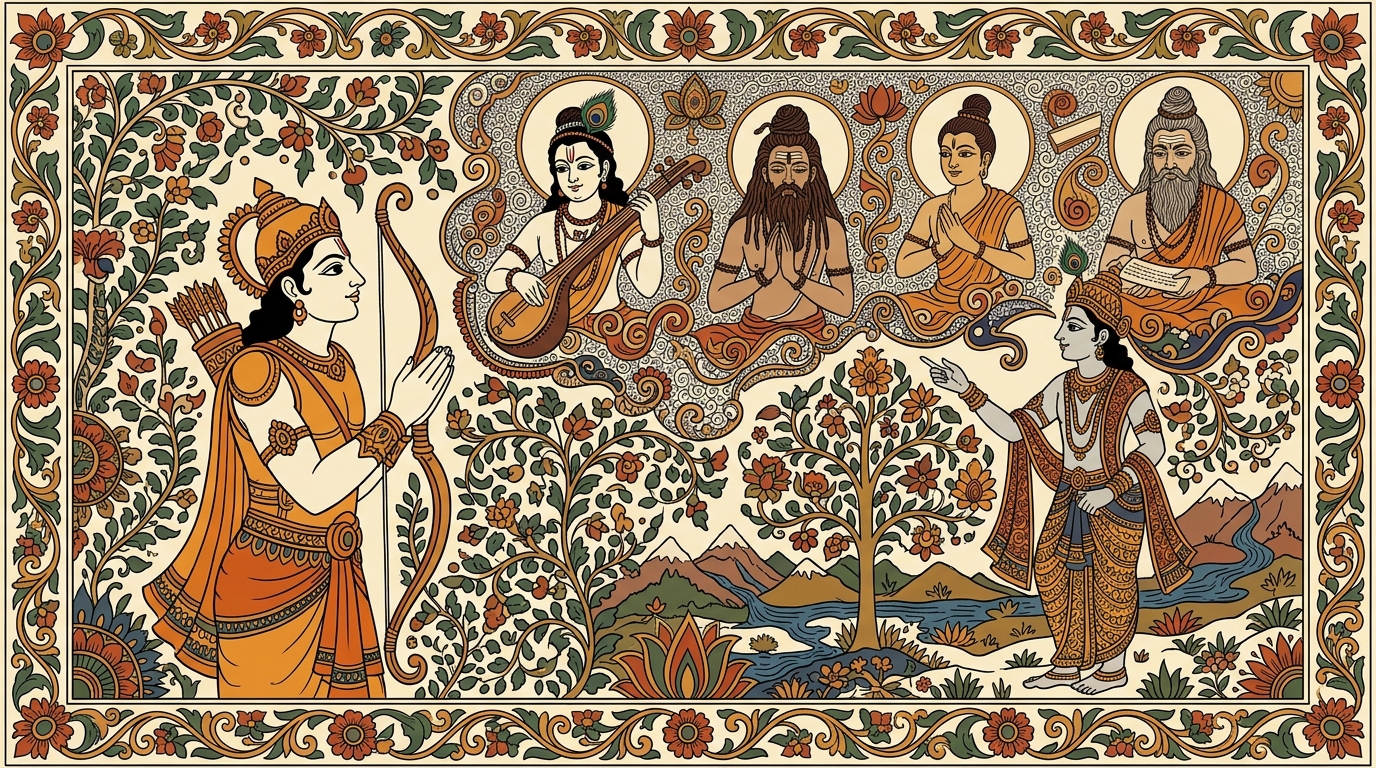
Still standing in the chariot with his palms pressed together, Arjuna
found his mind racing back through all the years of his life.
He remembered the long evenings of his boyhood, when wandering sages
would stop at the palace and the children would gather at their feet in
the lamplight. He remembered Narada most of all — the divine sage who
travelled between heaven and earth with his vina in his hands, his fingers
always brushing the strings. Narada had spoken of a Supreme Person behind
all the gods, a source older than the oldest god, deathless and shining.
Little Arjuna had listened, half-understanding, and tucked the words away.
He remembered the sage Asita, grave and quiet, who had said the same. And
Devala. And above them all he remembered Vyasa — the great rishi who knew
the past and the future, who had arranged the Vedas and would one day tell
the whole story of their family. Vyasa too had spoken of this Supreme One.
All his life Arjuna had carried these teachings the way you carry a
folded letter you have not yet had reason to open. The sages declare You,
he thought. They always declared You. Narada with his vina, Asita, Devala,
Vyasa — every one of them pointed to the same truth.
And now here it was, no longer in a letter, no longer a story heard at a
sage's feet. Here it was, alive, sitting an arm's length away from him,
holding the reins of his own chariot.
"All the sages say this of You," Arjuna said aloud, wonder breaking through
his voice. "The divine sage Narada says it. Asita and Devala say it. Vyasa
himself says it. Every wise one I have ever listened to spoke of a Supreme
Person — and now You, with Your own mouth, are telling me that it is You."
It was the strangest and most beautiful feeling: to have everything the
teachers ever told you suddenly stand up and prove itself true, right in
front of your face. The words of the sages and the word of his friend had
become one word. Arjuna believed them both, because they were the same.