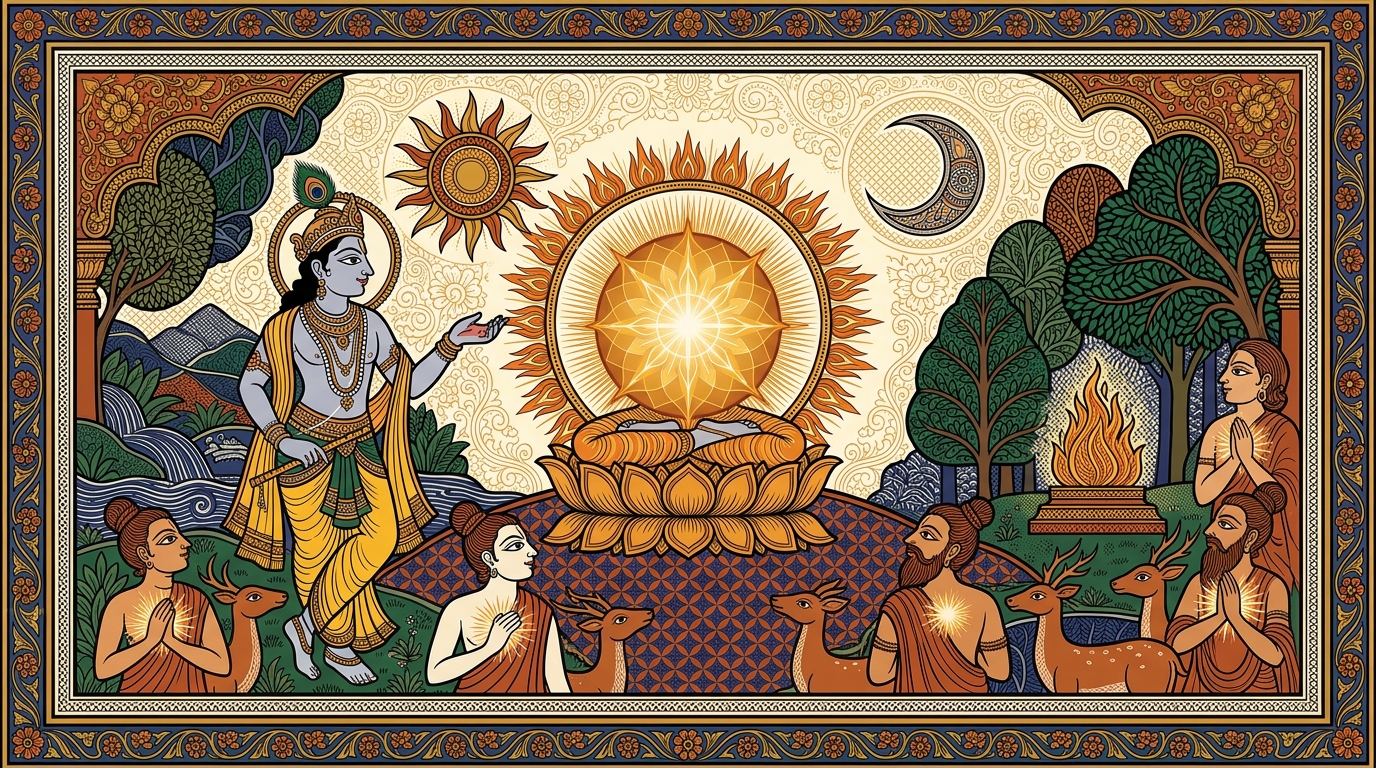
Deep in a mountain cave, where the daylight never reached, a sage had been
sitting in meditation since before the boy came.
Nachiketa, for that was the boy's name, had climbed all morning to find
him, and now he stood at the cave mouth, peering into the dark. "Holy one,"
he called, "I have come a long way to ask: what is the light that does not
go out?"
"Come in," said a voice from the blackness. "But you cannot see in here."
Nachiketa stepped into the cave. The sunlight fell away behind him. Soon he
could not see his own hand before his face. The dark pressed close and cold.
"Tell me, boy," came the sage's calm voice. "Out there in the world — what
makes things shine?"
"The sun, holy one. And at night the moon. And in our homes, the cooking
fire and the oil lamp."
"And if I took away the sun, the moon, every fire and every lamp — like this
cave — would there be any light left in the world?"
"No," said Nachiketa. "There would only be darkness. Like now."
The sage was quiet for a moment. Then he said: "Yet you are not afraid. You
came in. You are thinking, remembering, knowing that I am here even though
you cannot see me. Something in you is awake in the dark. What lamp lit
that?"
Nachiketa stood very still. It was true. The cave was black, yet inside him
something was bright and watchful — the part of him that knew, that was
aware, that had not gone dark when the sunlight vanished. No lamp had lit it.
No darkness could touch it.
"That," said the sage softly, "is the light of all lights. The sun shines,
but who knows the sun is shining? You do. By what light do you know it? By
this inner light, the light of the Self. It is brighter than the sun,
because it is the seeing behind all sun-seeing. No night can blow it out. It
sits here—" and though Nachiketa could not see, he felt the sage's hand rest
gently over his own heart "—in the cave of every heart, waiting to be found."
Nachiketa closed his eyes there in the dark cave. With his eyes shut, the
blackness was no deeper than before. And quietly, steadily, the little light
inside him went on shining, the way it always had, the way it always would.