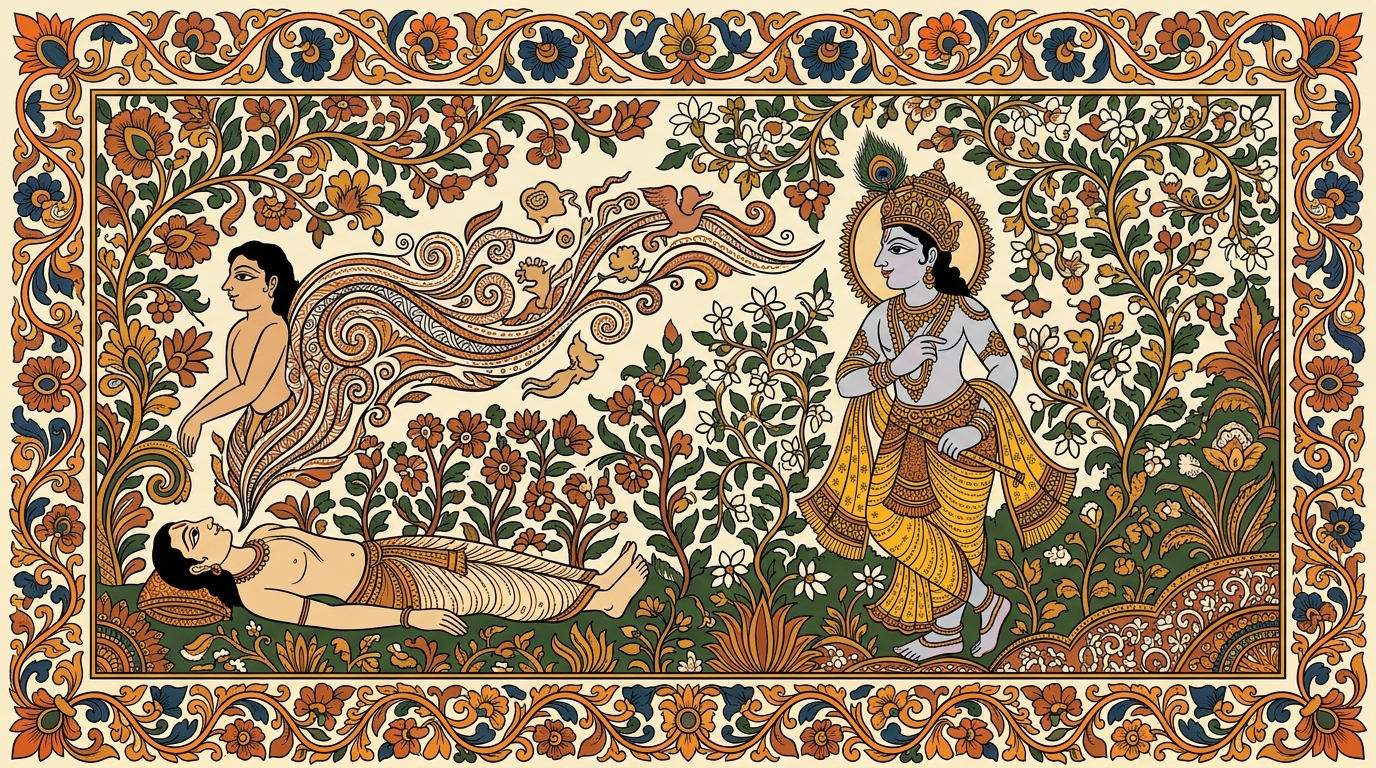
No one knew his name.
He was one of the thousands — a foot soldier from a village three
days' walk south of Hastinapura, a man who had tended goats before
the war and would have tended goats after it if a stray arrow had
not found the gap between his shoulder plate and his neck guard in
the final hour of the ninth day's fighting.
He lay on the field as the sun went down, the red dust of Kurukshetra
settling on his armour like a second skin. Around him, the sounds of
battle were fading — the crash of chariots thinning to distant
rumbles, the shouts of warriors dissolving into the low moans of the
wounded.
A breeze came from the south, from the direction of home, and it
carried something impossible: the faintest thread of sweetness, like
flowers blooming somewhere far away. It lasted only a breath. But it
was enough to loosen something in his chest, the way a single warm
day loosens the grip of winter.
A medic passed by, knelt briefly, and pressed the soldier's hand
before moving on to those who could still be helped. The touch
lingered — warm, human, real.
And the soldier was not afraid.
He was thinking about jasmine. The bush that grew outside his
mother's kitchen door in that village three days south — the one
that bloomed every monsoon, filling the house with a sweetness so
thick you could almost hold it in your hands. As a boy he would
stand in the doorway after the first rain and breathe it in until
his lungs ached. His mother would laugh and say, "Come eat your
roti. The jasmine isn't going anywhere."
But the jasmine did go somewhere. That was the thing about fragrance.
It never stayed in the flower. The wind came, invisible and gentle,
and carried it over the courtyard wall, across the lane, through
the mango orchard, out to the river where the dhobis washed their
clothes. The flower remained on the bush, white and still. The
scent travelled the world.
The soldier's breathing slowed. The red sky above him softened to
violet. He could not feel the arrow anymore. He could not feel the
dust. What he could feel — and this surprised him, because it was
so clear, so present, as if it were happening now rather than twenty
years ago — was the jasmine.
Not the memory of it. The jasmine itself. Cool, sweet, impossibly
alive, filling his chest the way it had filled that kitchen doorway
after the monsoon rain.
And then, like wind lifting scent from a flower, something lifted
from his body. Not with violence. Not with pain. The way smoke rises
from a lamp when you blow it out — a soft, upward drift, carrying
everything that mattered and leaving the clay behind. His kindness.
His laughter. The way he whistled through his teeth when he was
happy. The love he had for goats and monsoon rain and his mother's
voice. All of it, gathered by an invisible wind and carried gently
into what came next.
The body lay still on the field of Kurukshetra. But the fragrance
was already travelling.