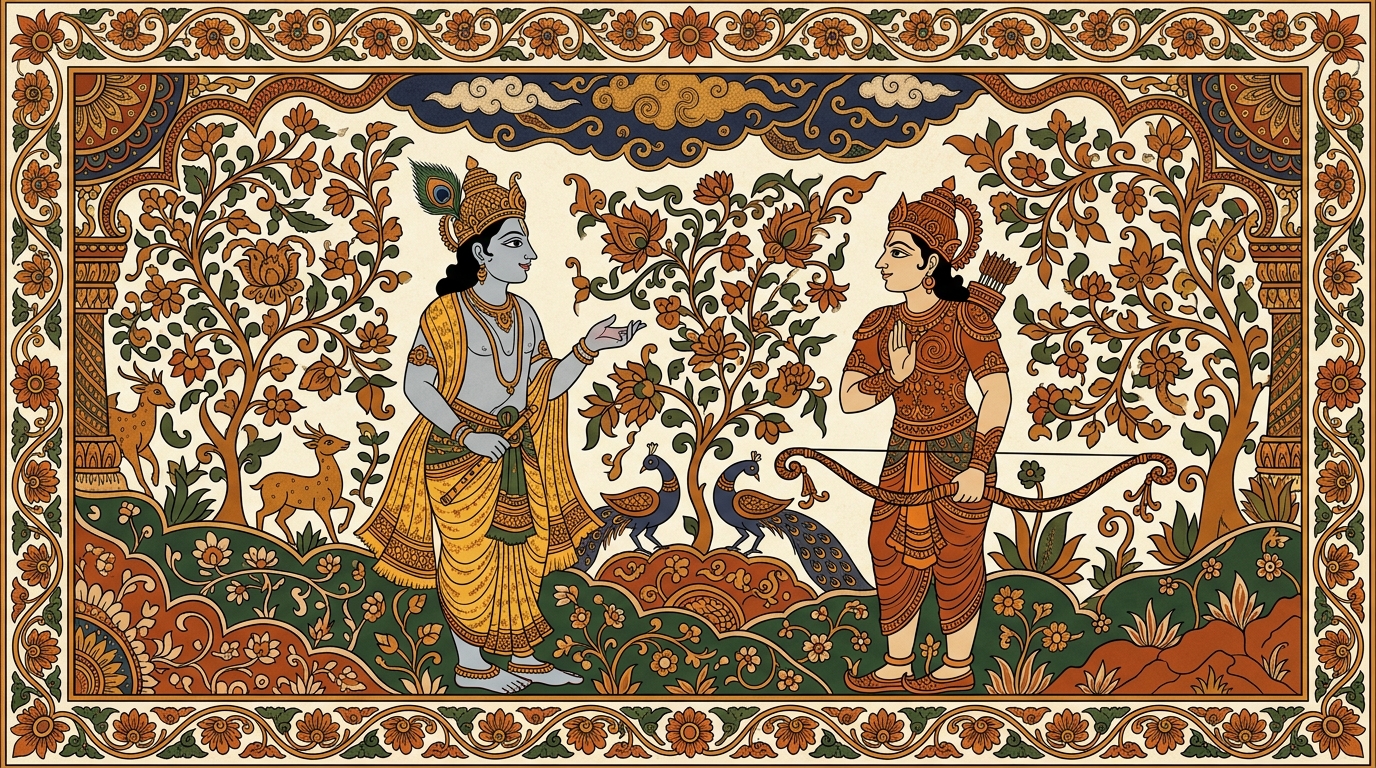
"Let me tell you about a gardener's son," said Krishna, settling the reins.
"His name was Nila, and he lived at the edge of a mango grove."
Arjuna leaned a little closer. He had always liked Krishna's stories.
"Every summer the mangoes ripened, and every summer the other children
rushed the trees at dawn — pushing, snatching, stuffing their pockets,
crying when a better mango went to someone else. They hated the bruised
fruit and longed for the golden ones, and so the whole grove, which should
have been a delight, became a place of squabbling and tears."
A horse swished its tail. Krishna went on.
"But Nila walked through the grove differently. When a ripe mango fell into
his hands, he ate it and was glad. When a sour one fell, he gave it to the
goats and was glad. He did not hate the sour fruit, and he did not crave
the sweet. He never elbowed anyone, never wept over a mango that rolled to
another child."
"And so he had fewer mangoes?" Arjuna asked.
Krishna laughed softly. "He had more. The other children, busy hating and
wanting, missed half of what fell. Nila, wanting nothing in particular,
received whatever came. The grove was a paradise to him while it was a
battlefield to them, and yet they all stood under the same trees."
He looked at Arjuna with quiet meaning.
"That boy was a true renouncer, though he never left the grove. He had
given up nothing on the outside and everything on the inside. He was not
pulled this way by liking and that way by disliking, and so nothing could
bind him. Joy and sorrow rolled past him like fruit on the grass."
The drum on the Kaurava side beat once, twice, and stopped.
"You do not have to flee the field to be free, Arjuna," Krishna said.
"You only have to stop grabbing. The one who neither clutches nor pushes
away walks out of every cage — easily, the way a door swings open when no
one is leaning on it."