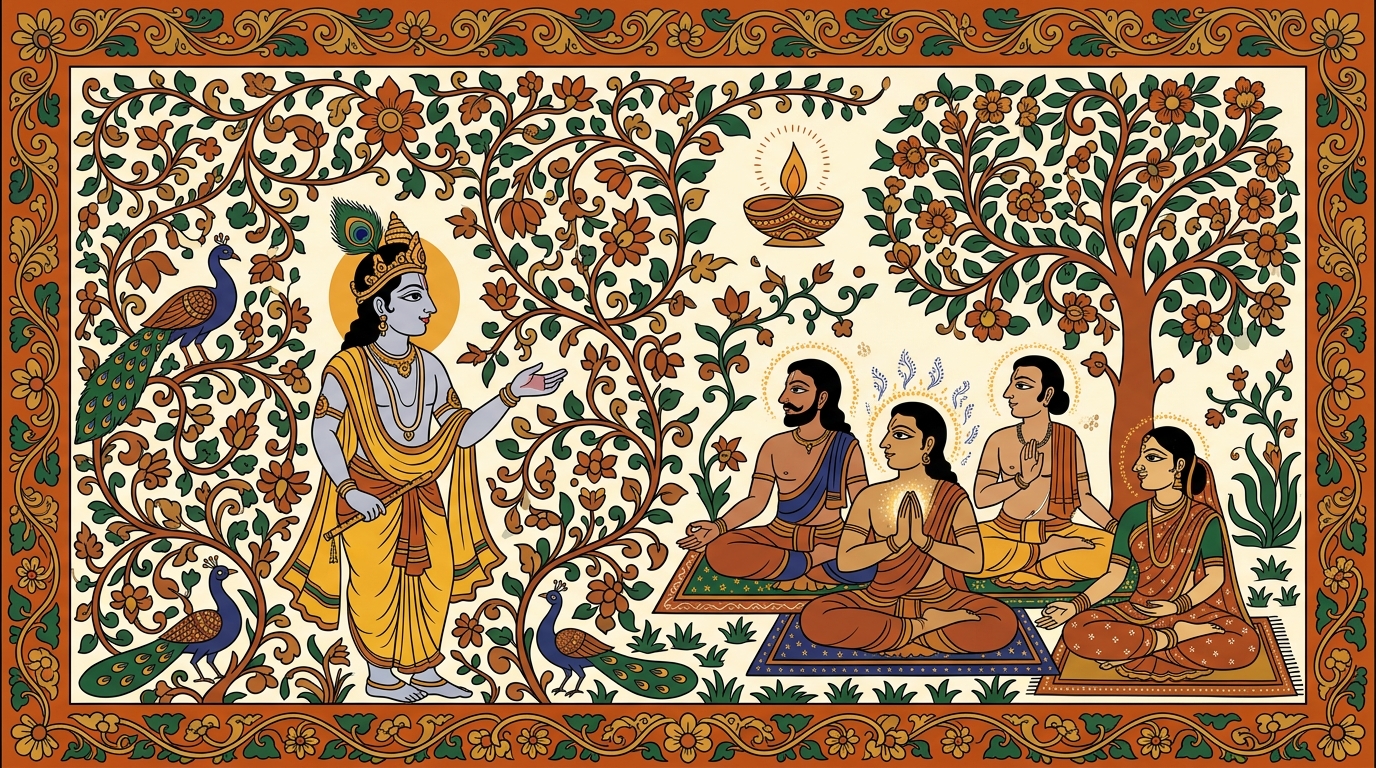
In a hill village above the war-plain lived an old potter named Hema,
and travellers spoke of her for one strange reason: her courtyard lamp
never went out.
Other lamps guttered in the evening wind that swept down from the
passes. They flared, shrank to a blue thread, and often died, leaving
people fumbling for flint. But Hema's lamp burned with a flame so steady
that it looked painted on the air. Children would stand and stare at it,
daring it to tremble. It never did.
"What is your secret, grandmother?" a boy asked one night.
Hema smiled and led him to the lamp. He saw then what the secret was.
She had built a small clay wall around three sides, and set the lamp
deep in a niche, sheltered. The wind still roared through the courtyard.
But the flame, tucked into its still place, did not feel it. The wind
could blow as it liked; the flame had somewhere it belonged.
"A flame in the open," Hema said, "goes wherever the wind pushes. It
leans east, then west, then east again, exhausting itself. But a flame
that has found its true place burns straight up, toward the sky, and the
storms pass over it."
Far below, in his chariot, Krishna was telling Arjuna about people like
that lamp. "When someone's whole understanding rests on the truth," he
said, "when their heart, their effort, and their goal are all the same
one thing, then the winds of the world — praise, blame, fear, hunger —
blow right past them. Knowledge has washed every stain from such people.
They have found the still place. And from that place, they do not return
to the old confusion. Their light goes steadily up."
Arjuna pictured the unflickering flame, and something in his chest grew
quiet.
Some lights are not blown out. They have simply come home.