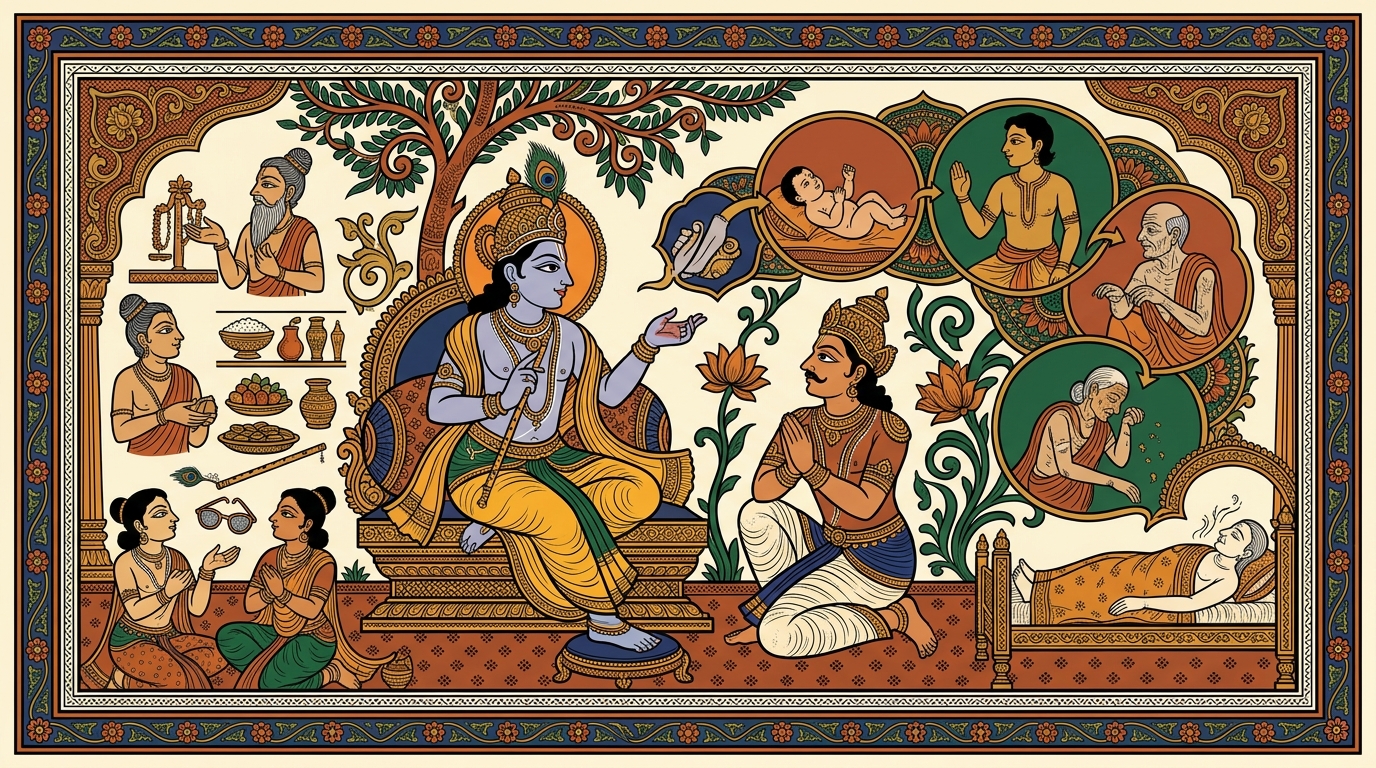
Prince Bharata had everything a boy could want.
He lived in a palace of white stone where fountains sang in the courtyards
and peacocks strutted across cool marble floors. Servants brought him sweets
stacked like little mountains. Musicians played whenever he wished. His
rooms were heaped with toys carved from sandalwood and ivory, and a hundred
people said "Yes, my prince" before he had even finished asking.
For a long while, this was enough. Bharata wanted a thing, and the thing
appeared, and he was happy — for an afternoon. Then he wanted the next
thing.
But Bharata was a thoughtful boy, and one day a question crept into his
mind and would not leave. He had watched his old nurse, once strong, now
walking bent over a stick, her hands trembling. He had seen his favourite
horse grow grey around the muzzle and slow in its step. He had stood quietly
at the edge of the room when a beloved court elder breathed his last.
"Everything I love," Bharata thought, "is changing. The sweets are gone the
moment I eat them. The toys grow dull. The people I love grow old. Even I,
who am young and strong now — one day I too will be the bent old one with
the trembling stick."
It was a heavy thought. But strangely, it did not crush him. It freed
something in him.
He went to a forest sage who lived simply beside a stream, owning nothing
but a deerskin and a clay bowl. "Teacher," Bharata said, "why do you seem
happier with nothing than I am with everything?"
The sage smiled. "Because, young one, you have begun to see what I have
seen. The body is born, grows old, sickens, and dies — and so does
everything it chases. When you stop expecting unchanging happiness from
changing things, you stop being yanked about by every craving. You can
enjoy the sweet without weeping when it ends. You can love your nurse
without breaking when she grows old. That clear seeing — that is not
sadness, child. That is the beginning of real wisdom."
Bharata went back to the palace. He still played, still laughed, still ate
the sweets. But something inside him no longer grabbed. He held the world
now with open hands.