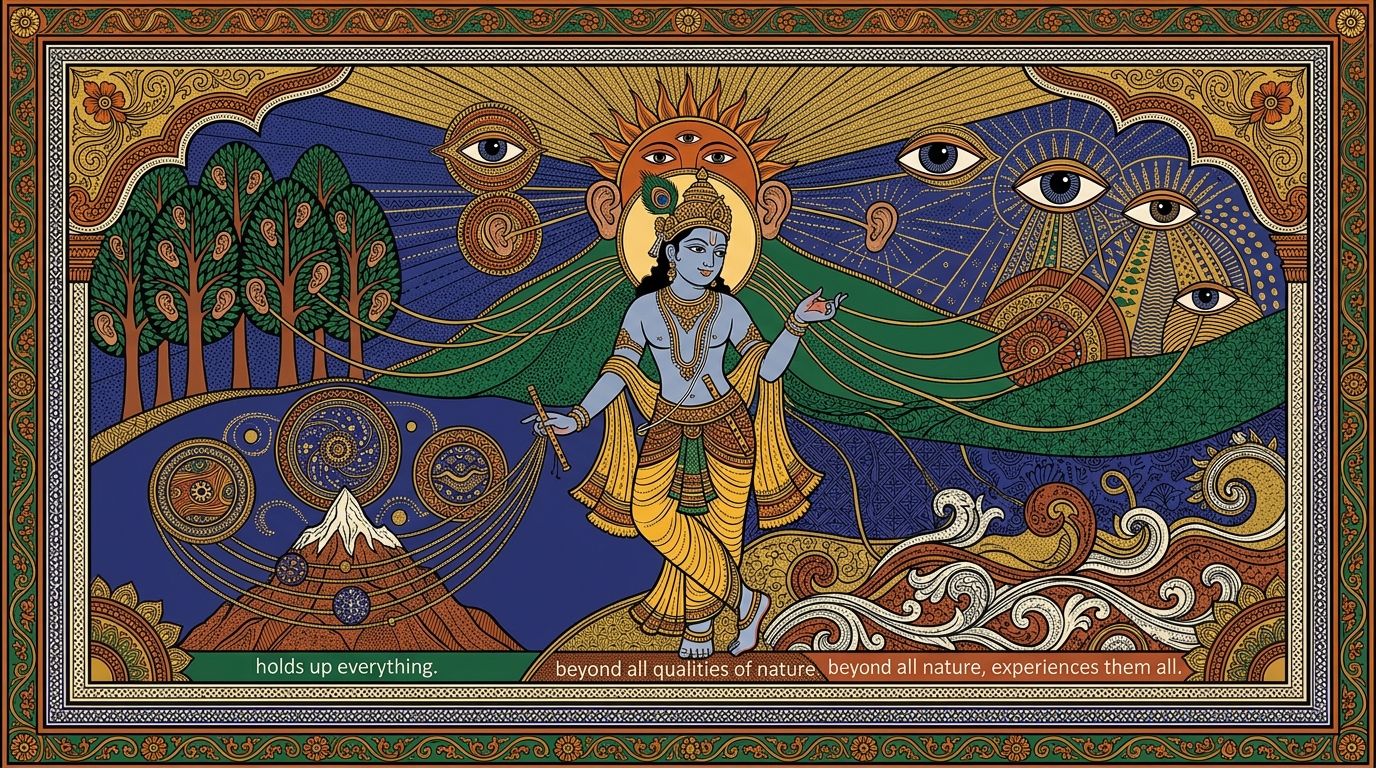
On a hill above the forest, an old rishi sat at dawn with three young
students, waiting for the sun.
The sky greyed, then blushed pink, then burst into gold as the sun lifted
over the trees. Birds woke. Dew on the grass began to glint. A spider's
web between two branches lit up like a string of tiny lamps.
"Look," said the rishi softly. "Tell me — how many eyes does the sun have?"
The students laughed. "None, teacher. The sun has no eyes."
"And yet," said the rishi, "without it, could your eyes see anything at
all?"
The students grew quiet. They looked at the world coming alive around them.
Without the sun, the green leaf would be just a grey shape in the dark. The
web would be invisible. Their own hands would be hidden. The sun did not
look at the leaf, the web, or the hand — and yet it was the sun that let
every eye see all of them.
"The Self is like this," the rishi said. "It does not see, the way your eye
sees. It does not hear, the way your ear hears. It has no senses of its own.
And yet it is the light by which all your seeing and hearing happen. When
your eye opens, it is the Self shining through it. When your ear catches a
bird's call, it is the Self that makes the catching possible."
The youngest student frowned. "But teacher, the sun is far away in the sky.
Is the Self far away too?"
The rishi smiled and touched the boy's chest. "The sun is far. This light
is nearer than your own heartbeat. It carries everything you feel — the cool
dew, the warm gold, the taste of the morning — yet it holds on to none of
it. The dew does not wet it. The gold does not stick to it. It is the one
that supports the whole bright world and stays untouched by all of it."
The sun climbed higher. The forest steamed gently in its warmth.
"Remember the sun without eyes," the rishi said, rising. "Remember the light
that lets all eyes see and needs no eye of its own. That is the closest you
will come to knowing the One you are looking for."
The students sat a long while, watching their own shadows shrink, thinking
about the seeing behind their seeing.