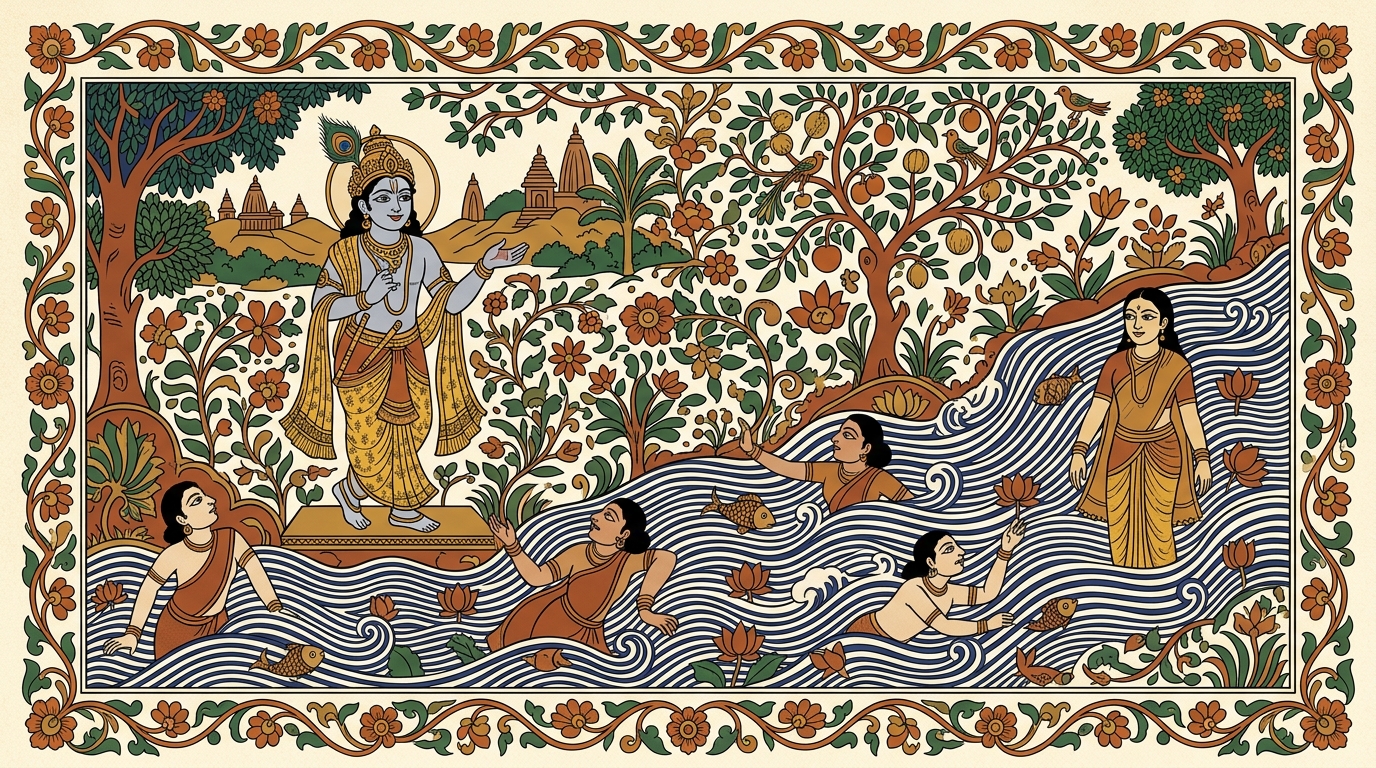
Near a village at the edge of a great forest there ran a river, and
in the dry months it was gentle enough for children to wade across.
But when the monsoon broke high in the hills, the river changed. It
came down brown and fast, carrying broken branches and the smell of
far-off rain.
A boy named Devan loved to stand in that river. Not to fight it — he
was not foolish — but to feel it. He would plant his feet wide on the
smooth stones, bend his knees, and let the water shove against his
shins. When a surge came, he did not lock himself stiff. He leaned,
he breathed, he let it pass around him. Then he stood tall again.
One evening Krishna, telling this to Arjuna on the chariot, smiled.
"An old fisherman watched Devan do this many times," he said. "One
day the fisherman asked him, 'Boy, why do you not simply step out
onto the bank where it is safe and dry?'"
"Devan thought about it. 'Because the bank is for after,' he said.
'I want to learn to stand while the water is still pushing. Anyone
can be steady on dry land.'"
Krishna let the words settle over the misty field.
"Inside each of us," he went on, "two rivers rise. One is desire —
the wanting that pulls us toward a thing until nothing else matters.
The other is anger — the heat that floods up so fast we forget who
we are. Both come as a surge, Arjuna. Both try to sweep us off our
feet before we have even decided to move."
Arjuna listened, very still.
"The hero is not the one who never feels the surge. Everyone feels
it. The hero is the one who, like Devan, plants his feet and lets it
pass through and around him, and is still standing when the water
quiets. He does not wait for some far-off day, after the body is
gone. He learns it here, now, while the river is loud."
Far away, thunder rolled in the hills, soft as a memory.
"And here is the secret the fisherman never guessed," Krishna said
gently. "The boy who can stand in the river is not grim. He is the
happiest one in the village. For he is afraid of no current at all."